Ostarine vs RAD-140: Preclinical Evidence Compared
Research compounds for laboratory use only · not medical advice
By Vyroval Research Desk — an institutional byline. PubMed-linked sources are checked against their indexed records; how this desk works.
The two most-searched SARMs compared on the only axes that hold up: receptor pharmacology, published human trial data (one has them, one doesn't), and what the enobosarm program's end tells researchers.
The two biggest names in the SARM aisle share a receptor and almost nothing else — least of all a human evidence base.
Pharmacology
Both are non-steroidal AR ligands; neither aromatizes (there’s no 17β-hydroxysteroid handle for aromatase to work with — the point of the class). The scaffold families differ: ostarine is the arylpropionamide prototype of the GTx program, RAD-140 the bicyclic aryl/quinuclidine design from the 2013 preclinical characterization (full AR selectivity comparison: Christiansen 2020 review). In direct binding work, RAD-140 is reported as the higher-affinity ligand — which is precisely the number marketing decks inflate into a dosing story it can’t support.
Evidence — the asymmetry is the article
Ostarine has human data, and it’s cautionary. Phase II in older adults: lean mass up, endogenous testosterone down dose-dependently (PMC3177038). The hip-fracture recovery program then halted after a mortality imbalance in the highest-dose arm — the single most-cited safety signal in the entire class.
RAD-140 has none. No registered completed human trials; everything published is design and preclinical characterization (Hwang 2013). “More potent in rats” is a legitimate research finding and an illegitimate human claim — the gap between those two sentences is the SARM market.
Analytical reality
Van Wagoner et al. (JAMA 2017) GC-MS/MS-audited 76 marketed “SARM” products: barely half matched their labels; unapproved pro-drug modifications (masked versions of S-4 and others) were discovered in the bottles themselves. If a study is buying “RAD-140” from a consumer channel, the independent variable may be an unknown compound. The research-grade response is batch COAs with mass data you can verify against the MW calculator — catalog pages: Ostarine, RAD-140, LGD-4033.
Research-use framing
Both compounds sit in the catalog as analytical reference materials for AR-pathway and doping-analysis research, at preclinical doses only, with the enobosarm outcome data stated on the page beside the CAS number. No dose here is a human recommendation; there are no human doses for this class.
For laboratory research use only. Not medical advice.
FAQ
Frequently asked questions
What is the main scientific difference between ostarine and RAD-140?
Scaffold and evidence depth. Ostarine (enobosarm) is an arylpropionamide with multiple completed human trials — the most-documented SARM pharmacologically. RAD-140 is a bicyclic aryl/quinuclidine design with published preclinical binding data but no completed human trials as of 2026.
Has either been approved?
Neither. Enobosarm's late-stage program in elderly muscle wasting ended after the hip-fracture studies, and the 25 mg/day arm showed a mortality imbalance that stopped further high-dose development. RAD-140 never entered the trial pipeline.
Which has more published research?
Ostarine, by a wide margin — phase II data in older adults showed lean-body-mass gain with dose-dependent testosterone suppression, plus the hip-fracture program literature. RAD-140's published profile is medicinal-chemistry and preclinical.
Why does the market still push RAD-140?
Because 'no human data' reads as 'potent' in marketing copy. The JAMA 2017 audit found much of what was sold as RAD-140 wasn't even RAD-140 — the product claims outran the analysis.
References
Selected literature for the compounds discussed
These papers are background literature on the compounds referenced above — they are not citations of this article.
- [1]Palmieri C., et al. "Activity and safety of enobosarm, a novel, oral, selective androgen receptor modulator, in androgen receptor-positive, oestrogen receptor-positive, and HER2-negative advanced breast cancer (Study G200802): a randomised, open-label, multicentre, multinational, parallel design, phase 2 trial." Lancet Oncol, 2024.
- [2]Crawford J., et al. "Study Design and Rationale for the Phase 3 Clinical Development Program of Enobosarm, a Selective Androgen Receptor Modulator, for the Prevention and Treatment of Muscle Wasting in Cancer Patients (POWER Trials)." Curr Oncol Rep, 2016.
- [3]Brown A.M., et al. "RAD140 (Testolone) negatively impacts skeletal muscle adaptation, frailty status and mortality risk in female mice." Clin Exp Pharmacol Physiol, 2023.
- [4]Yu Z., et al. "Selective Androgen Receptor Modulator RAD140 Inhibits the Growth of Androgen/Estrogen Receptor-Positive Breast Cancer Models with a Distinct Mechanism of Action." Clin Cancer Res, 2017.
- [5]Basaria S., et al. "The safety, pharmacokinetics, and effects of LGD-4033, a novel nonsteroidal oral, selective androgen receptor modulator, in healthy young men." J Gerontol A Biol Sci Med Sci, 2013.
Keep reading
Related articles
Andarine (S-4): The First-Generation SARM Standard
Andarine is the molecule that defined the SARM template — and the one whose retinal off-target findings defined the limits of the selectivity claim. Chemistry, detection and handling.
LGD-4033 (Ligandrol): The Human-Trial SARM
Ligandrol is one of few SARMs with published human-phase data — and that data is precisely what makes it a documentation-first research compound. Chemistry, trial record, and analytical specs.
Ostarine (MK-2866): The Prototype SARM, Revisited
Enobosarm is the most studied SARM in the catalog: phase II human data, a single stereocentre that decides what the standard actually is, and a documentation trail worth reading before any assay.
Laboratory tools
Put it into practice
From the catalog
Reference compounds
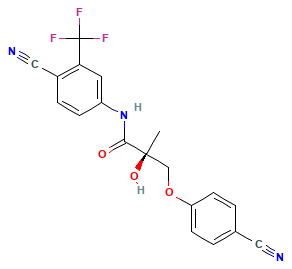
Ostarine (Enobosarm)
Aryl-propionamide SARM reference standard. GTx's phase II compound.
CAS 841205-47-8
Ships in 3–5 days10mg vial · In stock
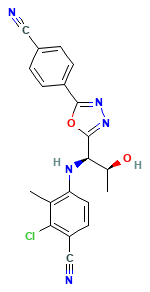
Testolone (RAD-140)
High-affinity benzyl-propionamide SARM from Ligand's preclinical series.
CAS 1182367-47-0
Ships in 3–5 days10mg vial · In stock
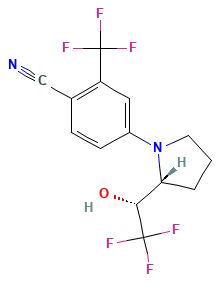
Ligandrol (LGD-4033)
Fluorophenyl oxadiazole-class SARM studied in bone-mass protocols.
CAS 1165910-22-4
Ships in 3–5 days10mg vial · In stock
For laboratory research use only