SARMs for Research: What the Class Really Is
Research compounds for laboratory use only · not medical advice
By Vyroval Research Desk — an institutional byline. PubMed-linked sources are checked against their indexed records; how this desk works.
A level-headed guide to selective androgen receptor modulators as research compounds — scaffold families, why 'selective' was the point, the mislabeling scandal that defines the market, and what legitimate SARM research looks like.
“SARM” is the most misunderstood three letters in the research-chemical market — simultaneously a legitimate pharmacological class and, as sold online, a byword for mislabeled bottles. This guide separates the class from the commerce.
The idea: biased agonism, decades early
SARMs were born in 1990s medicinal chemistry — the linolenic-acid-derived precursors at Allergan, then the propionamide and arylquinuclidine scaffolds — as an attempt to split the androgen signal: keep receptor activation in muscle and bone, reduce it in prostate and skin. Modern mechanistic work shows the “selectivity” is tissue-specific cofactor recruitment rather than clean on/off, which is exactly the interesting part for AR-signaling research (review with full pipeline table: Christiansen 2020).
Four properties define the class analytically: non-steroidal or 19-nor scaffolds, oral bioavailability without 17α-alkylation, no aromatase substrate behavior, and dose-dependent (not zero) suppression of the HPG axis in human trials — the enobosarm phase II data in older adults showed lean-mass gains alongside measurable testosterone suppression (PMC3177038).
The scaffold families in the catalog
| Family | Prototype | Chemistry handle |
|---|---|---|
| Propionamide (S-4-type) | Andarine S-4 | 1,2-diaryl-5-aminoimidazole scaffold; visual-side-effect literature in trials |
| Arylpropionamide (QT/OSTX-type) | Ostarine, LGD-4033 | The most-published SARM scaffold; enobosarm programs |
| Bicyclic aryl (GTX-type) | RAD-140 | Design rationale and preclinical profile: Hwang 2013 |
| Rev-erb agonist (adjacent class) | SR-9009 | Not an AR ligand at all — circadian-clock pathway tool sold in SARM aisles |
| GH secretagogue (adjacent) | MK-677 | Ghrelin-receptor mimetic; the Nass 2008 RCT is its clinical benchmark |
Note the two “adjacent” rows: market categorization and pharmacology routinely disagree — a pattern worth internalizing before buying anything called a SARM.
Why this market has a reputation problem
Van Wagoner et al. ran GC-MS/MS on 76 products marketed online as SARMs (JAMA 2017): barely half matched their labels; the rest contained undisclosed pro-drugs, other active agents, or sub-therapeutic amounts — findings the authors tied directly to case reports of drug-induced liver injury. The LiverTox chapter is the sober summary: no SARM is approved anywhere, several have documented hepatotoxicity signals, and the supplement-channel products are analytically unreliable as a class. That paper is also the strongest argument for the batch-tested, CAS-documented catalog model: the research answer to a broken market is documentation.
What legitimate use looks like
Receptor and signaling research with published preclinical doses, doping-control method development, and reference-standard work — all of which need exactly what the gray market lacks: verified identity per batch. That’s the lane these compounds occupy here (quality process), and the reason every product page states the trial failures as plainly as the assay interest.
Not approved at any dose, by any route, for human use — and the WADA prohibited list treats all of them as banned substances in sport.
For laboratory research use only. Not medical advice.
FAQ
Frequently asked questions
What is a SARM?
A selective androgen receptor modulator: a non-steroid or steroid-derived molecule that activates the androgen receptor with tissue-biased signaling — designed in the 1990s to keep the anabolic effects of testosterone while reducing androgenic side effects, for conditions like muscle wasting and osteoporosis.
Are any SARMs FDA-approved?
None. Enobosarm (Ostarine) reached phase II/III trials and the largest completed programs failed their primary functional endpoints — which is why every SARM on the market is a research chemical, not a drug.
Why do analysts keep finding mislabeled SARM products?
The defining market study — Van Wagoner et al., JAMA 2017 — GC-MS/MS tested 76 'SARM' products sold online: only about half contained what the label claimed; others were unapproved pro-drugs, other drugs entirely, or under-dosed. The market's analytical reputation comes from that paper.
What is legitimate SARM research?
AR-signaling selectivity models (the original purpose), muscle-wasting and bone-density animal studies with published dose ranges, receptor-binding assays, and doping-analysis method development — SARMs are WADA-prohibited and their metabolites are LC-MS/MS targets.
References
Selected literature for the compounds discussed
These papers are background literature on the compounds referenced above — they are not citations of this article.
- [1]Palmieri C., et al. "Activity and safety of enobosarm, a novel, oral, selective androgen receptor modulator, in androgen receptor-positive, oestrogen receptor-positive, and HER2-negative advanced breast cancer (Study G200802): a randomised, open-label, multicentre, multinational, parallel design, phase 2 trial." Lancet Oncol, 2024.
- [2]Crawford J., et al. "Study Design and Rationale for the Phase 3 Clinical Development Program of Enobosarm, a Selective Androgen Receptor Modulator, for the Prevention and Treatment of Muscle Wasting in Cancer Patients (POWER Trials)." Curr Oncol Rep, 2016.
- [3]Brown A.M., et al. "RAD140 (Testolone) negatively impacts skeletal muscle adaptation, frailty status and mortality risk in female mice." Clin Exp Pharmacol Physiol, 2023.
- [4]Yu Z., et al. "Selective Androgen Receptor Modulator RAD140 Inhibits the Growth of Androgen/Estrogen Receptor-Positive Breast Cancer Models with a Distinct Mechanism of Action." Clin Cancer Res, 2017.
- [5]Basaria S., et al. "The safety, pharmacokinetics, and effects of LGD-4033, a novel nonsteroidal oral, selective androgen receptor modulator, in healthy young men." J Gerontol A Biol Sci Med Sci, 2013.
Keep reading
Related articles
Andarine (S-4): The First-Generation SARM Standard
Andarine is the molecule that defined the SARM template — and the one whose retinal off-target findings defined the limits of the selectivity claim. Chemistry, detection and handling.
LGD-4033 (Ligandrol): The Human-Trial SARM
Ligandrol is one of few SARMs with published human-phase data — and that data is precisely what makes it a documentation-first research compound. Chemistry, trial record, and analytical specs.
Ostarine (MK-2866): The Prototype SARM, Revisited
Enobosarm is the most studied SARM in the catalog: phase II human data, a single stereocentre that decides what the standard actually is, and a documentation trail worth reading before any assay.
Laboratory tools
Put it into practice
From the catalog
Reference compounds
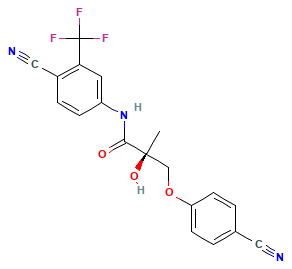
Ostarine (Enobosarm)
Aryl-propionamide SARM reference standard. GTx's phase II compound.
CAS 841205-47-8
Ships in 3–5 days10mg vial · In stock
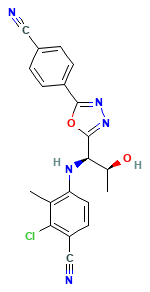
Testolone (RAD-140)
High-affinity benzyl-propionamide SARM from Ligand's preclinical series.
CAS 1182367-47-0
Ships in 3–5 days10mg vial · In stock
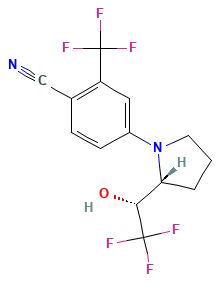
Ligandrol (LGD-4033)
Fluorophenyl oxadiazole-class SARM studied in bone-mass protocols.
CAS 1165910-22-4
Ships in 3–5 days10mg vial · In stock
For laboratory research use only